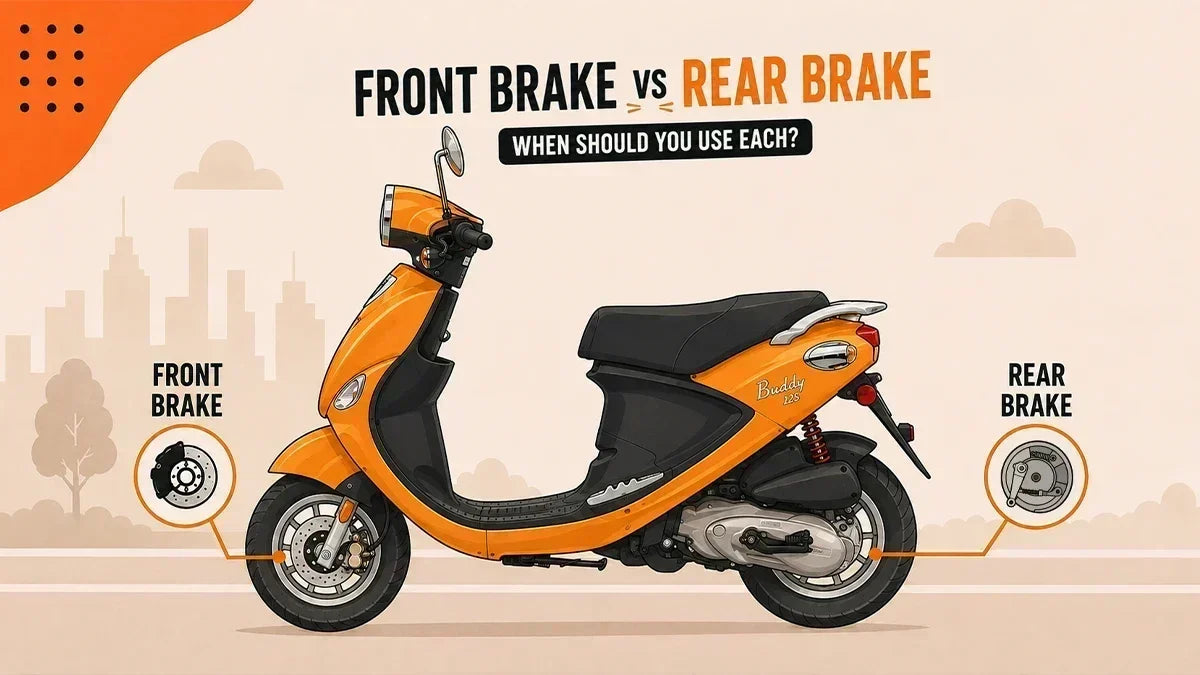
When you're riding a scooter, braking might seem pretty straightforward: squeeze the brake lever and slow down. But your scooter's front and rear brakes actually play different roles, and knowing how to use them properly can make a big difference in how safely and confidently you ride.
Whether you're riding a 50cc commuter, a larger 170cc scooter, or something in between, understanding your brakes is an important part of becoming a better rider. At Genuine Scooters, we believe that knowing how your scooter works is just as important as knowing how to ride it.
So, when should you use the front brake, the rear brake, or both?
The Short Answer: Use Both
For most normal riding situations, you should use both the front and rear brakes together.
The front brake generally provides the majority of your stopping power because braking causes the scooter's weight to shift toward the front wheel. The rear brake helps contribute additional stopping power while helping keep the scooter stable and controlled.
Using both brakes allows the scooter to slow down more effectively while distributing braking forces between the two wheels.
That doesn't mean you should grab the front brake as hard as possible. Smooth, progressive braking is the key.
How Does the Front Brake Work?
The front brake is responsible for a large portion of your scooter's stopping power.
When you apply the brakes, the scooter's weight shifts forward. This puts more weight and traction on the front tire, allowing the front brake to generate more stopping force.
This is why the front brake is particularly important when you need to make a quick stop.
The important part is how you use it. Instead of suddenly grabbing the brake lever, apply the front brake smoothly and progressively. As the scooter slows and weight transfers forward, you can increase braking pressure as needed.
On many scooters, the front brake is a disc brake, although some scooters use a drum brake.
How Does the Rear Brake Work?
The rear brake works on the rear wheel and provides additional stopping power and stability.
Because braking transfers weight toward the front of the scooter, there is less weight pressing down on the rear tire during hard braking. That means the rear wheel can lock up more easily if you apply too much rear-brake pressure.
A locked rear wheel can cause the scooter to skid, which is why smooth braking is important here as well.
The rear brake can be especially useful when you're:
- Making gentle, low-speed stops
- Maneuvering through a parking lot
- Managing your speed through a turn
- Riding in situations where you want subtle speed control
- Combining it with the front brake during normal stops
Depending on the scooter, the rear brake may be operated by the opposite handlebar lever or by a foot-operated pedal.
Why Does Weight Transfer Matter?
Understanding weight transfer is one of the most important concepts when learning how to brake.
Imagine your scooter traveling forward. When you apply the brakes, the scooter's momentum causes weight to shift toward the front wheel.
That's why the front tire gains traction while the rear tire becomes lighter.
This is also why simply treating the front and rear brakes as equal isn't ideal. They don't have the same amount of traction available during braking.
More traction means more potential braking force.
That's also why the front brake generally does more of the work during a hard stop.
When Should You Use the Front Brake?
For everyday riding, the front brake should be part of your normal braking technique.
Use it smoothly when you need to:
- Slow down for traffic
- Stop at an intersection
- Reduce speed quickly
- Make an emergency stop
- Stop from higher speeds
The faster you're traveling, the more important effective front braking becomes.
The key is smooth and controlled pressure rather than a sudden grab.
When Should You Use the Rear Brake?
The rear brake is useful on its own in certain low-speed situations, but it shouldn't normally be your only source of braking power when traveling at speed.
For example, you might use primarily the rear brake when maneuvering slowly through a parking lot or making very small speed adjustments.
At higher speeds, combining the rear brake with the front brake generally provides better overall braking performance.
What About Emergency Stops?
When you need to stop quickly, use both brakes.
Apply both brakes firmly and progressively while keeping the scooter upright and traveling in a straight line whenever possible.
Avoid abruptly grabbing either brake. A sudden application can cause a wheel to lock, particularly if the road surface is wet, loose, or otherwise low in traction.
During a hard stop, the front brake will typically provide more stopping power because of forward weight transfer. The rear brake still contributes, but you need to be mindful that the rear wheel has less traction as weight moves forward.
If you have access to a safe, controlled area, practicing emergency braking at different speeds can help you understand how your particular scooter responds.
Should You Ever Use Just One Brake?
Yes, there are situations where using one brake can make sense, particularly at very low speeds.
But as a general rule:
Normal riding = use both brakes.
Relying exclusively on the rear brake can significantly increase stopping distance, while aggressively using only the front brake can make braking less controlled, especially if the surface is slippery or uneven.
Learning to smoothly coordinate both brakes is a much better habit.
Front Disc Brake vs. Rear Drum Brake
Many scooters use different types of brakes on the front and rear wheels.
A common setup is a front disc brake and rear drum brake.
Disc brakes use a caliper and brake pads to clamp onto a rotating disc attached to the wheel. Drum brakes use brake shoes that press outward against the inside of a rotating drum.
Both systems can provide effective braking when properly maintained. The specific setup varies depending on the scooter.
Regardless of the type of brake your scooter uses, proper maintenance and correct riding technique matter more than simply knowing which type is installed.
What Should You Check on Your Scooter?
Good braking starts with a properly maintained scooter.
Regularly check:
- Brake pad or shoe wear
- Brake lever feel
- Brake cable or hydraulic system condition
- Brake fluid level, if equipped
- Tire condition and inflation
- Unusual noises or vibrations
- Changes in braking performance
If your brake lever suddenly feels different, your scooter pulls to one side while braking, or your stopping distance seems longer than normal, have the braking system inspected before continuing to ride.
Your tires are also a critical part of the braking system. Brakes can only work as effectively as the available traction between your tires and the road.
Practice Makes Better
Knowing which brake to use is only part of becoming a confident rider. Developing smooth braking habits takes practice.
Find a safe, open area away from traffic and practice gradually slowing down using both brakes. As you become comfortable, practice controlled stops from different speeds.
The goal isn't simply to stop as quickly as possible. It's to develop smooth, predictable braking that you can rely on when you actually need it.
At Genuine Scooters, we think understanding your scooter is part of the fun of riding. The more you know about how your scooter works, the more confidently you can ride it.
The Bottom Line
Use both brakes for most stops.
The front brake generally provides the majority of your stopping power because braking shifts weight toward the front wheel. The rear brake adds stopping power and helps you control the scooter, particularly during low-speed riding and normal stops.
Use both smoothly, avoid sudden grabs, maintain your brakes and tires, and practice in a safe environment.
A little knowledge about how your brakes work can go a long way toward becoming a safer, more confident scooter rider.
Practice Makes Better
Should I use the front or rear brake on a scooter?
For most normal stops, you should use both the front and rear brakes together. The front brake generally provides more stopping power because braking transfers weight toward the front wheel, while the rear brake provides additional braking force and control.
Is the front brake more important than the rear brake?
The front brake generally provides more stopping power, especially during harder braking, because weight shifts toward the front wheel. However, the rear brake is still important and should normally be used together with the front brake.
Can I use only the rear brake on a scooter?
You can use the rear brake by itself during some low-speed situations, such as maneuvering through a parking lot. At higher speeds, relying only on the rear brake can increase stopping distance.
Should I use both brakes during an emergency stop?
Yes. For an emergency stop, apply both brakes firmly and progressively while keeping the scooter as upright and straight as possible. Avoid abruptly grabbing either brake.
Why does the rear wheel skid when I brake hard?
Hard braking transfers weight toward the front of the scooter, reducing the traction available at the rear wheel. Applying too much rear-brake pressure can cause the rear wheel to lock and skid.
Does a scooter need both a front and rear brake?
Scooters are designed with front and rear braking systems to provide controlled and effective stopping. The exact brake configuration varies between models.






Leave a comment
This site is protected by hCaptcha and the hCaptcha Privacy Policy and Terms of Service apply.