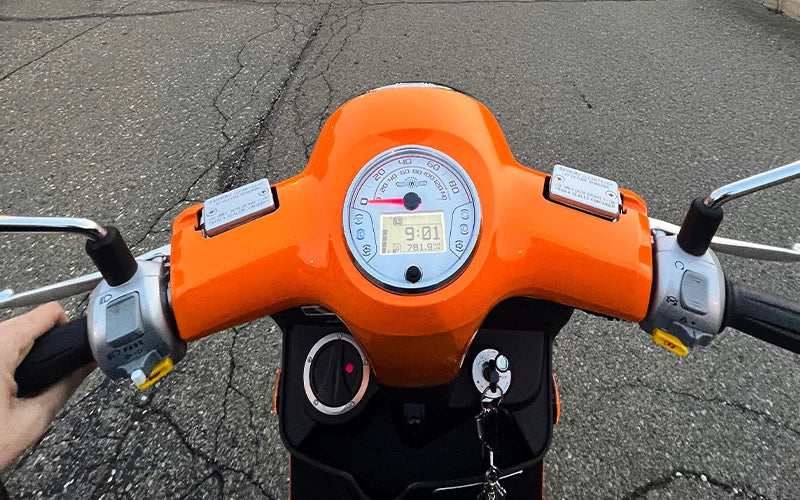
One of the most common questions people have when shopping for a scooter is: How fast does a scooter need to go to keep up with traffic?
The answer depends on where you ride.
A scooter that is perfect for neighborhood streets and city traffic may not be the best choice for a road where vehicles regularly travel 45 or 50 mph. On the other hand, choosing a larger, faster scooter than you actually need can mean paying for performance you may rarely use.
The right question isn't simply, "How fast can this scooter go?"
It's "How fast does my scooter need to go for the roads I actually ride?"
What Does "Keeping Up With Traffic" Mean?
Keeping up with traffic doesn't mean riding as fast as every vehicle around you.
Traffic speeds change constantly. Cars may accelerate quickly from a stoplight, slow down for an intersection, or travel faster or slower than the posted speed limit.
For scooter riders, keeping up with traffic generally means having enough performance to travel comfortably at the prevailing speed of the road without becoming an obstacle or riding beyond the scooter's capabilities.
That's why the type of road you ride is so important.
A 25 mph neighborhood street has very different requirements from a 45 mph arterial road.
25–30 MPH Streets: Where Smaller Scooters Shine
Many urban and residential streets have speed limits around 25 or 30 mph. These roads are often a natural fit for smaller scooters.
The Genuine Buddy 50 and RoughHouse 50 are examples of scooters designed around this type of riding. Both use 49.7cc two-stroke engines and have a listed top speed of up to 30 mph in their current configurations. The RoughHouse 50 is specifically positioned for city streets, neighborhood riding, and short commutes.
That makes a 50cc scooter a practical option when your everyday riding consists primarily of:
- Neighborhood streets
- Residential areas
- Lower-speed city roads
- Short trips around town
- Routes with frequent stops and intersections
- Roads where traffic generally travels around 25–30 mph
A 50cc scooter isn't designed to keep up with every type of traffic. But for the right environment, you may not need anything faster.
Traffic Conditions Matter
Even on a 30 mph road, traffic can move differently depending on the time of day, number of lanes, hills, and surrounding development.
If vehicles routinely travel significantly faster than the posted speed limit, you should consider that when choosing a scooter and planning your route.
35–45 MPH Roads: Consider More Performance
Once you start riding on roads where traffic regularly moves around 35–45 mph, having additional engine performance becomes increasingly useful.
This is where a 125cc scooter can make a noticeable difference.
For example, the Genuine Buddy 125 is rated for a top speed of up to 50 mph, while the Buddy Kick 125i is rated for up to 55 mph. Both give riders more speed and acceleration potential than a typical 50cc scooter.
That additional performance can be useful for:
- Longer urban commutes
- Roads with 35–45 mph speed limits
- Routes with hills
- Roads where traffic moves more quickly
- Riders who want more flexibility between city streets and faster roads
Again, the goal isn't necessarily to ride at the scooter's maximum speed. Having extra performance means the scooter doesn't have to work at its limit simply to maintain a reasonable speed.
What About the Buddy 170i and Hooligan 170i?
For riders who regularly encounter faster traffic, a scooter such as the Genuine Buddy 170i or Hooligan 170i provides another step up in performance.
These scooters are designed for riders who want more power and additional capability than a 50cc or 125cc scooter provides. The Genuine lineup currently includes both the Buddy 170i and Hooligan 170i.
A larger-displacement scooter can be especially appealing if your riding includes:
- Faster city roads
- Longer commutes
- Steeper hills
- Frequent acceleration from traffic lights
- Roads where you want more performance in reserve
The advantage isn't simply having a higher top speed. More engine performance can make it easier to accelerate and maintain speed as traffic conditions change.
Don't Choose a Scooter Based Only on Top Speed
Top speed gets a lot of attention when shopping for a scooter, but it isn't the only thing that matters.
Consider what happens between zero and your normal cruising speed.
If you're riding through a city, you may spend more time accelerating from stoplights than riding at maximum speed. In that situation, acceleration, handling, braking, and overall ease of use can be just as important as top speed.
Rider weight, hills, wind, passenger weight, and cargo can also affect real-world performance.
That's why two scooters with similar advertised top speeds can feel different on the road.
Think About Your Actual Commute
Before choosing a scooter, look at the roads you actually plan to ride.
Don't just look at the speed limit. Think about how traffic behaves on those roads.
For example:
If your commute is mostly 25–30 mph neighborhood streets:
A 50cc scooter such as the Buddy 50 or RoughHouse 50 may be a great fit.
If your commute includes 35–45 mph city roads:
A 125cc scooter such as the Buddy 125 or Buddy Kick 125i may provide more flexibility.
If your commute regularly includes faster traffic, hills, or longer stretches of open road:
A larger scooter such as the Buddy 170i or Hooligan 170i may provide the additional performance you're looking for.
These aren't hard rules. They're simply a useful way to think about matching scooter performance to your riding environment.
What About Hills?
A road's speed limit doesn't tell the whole story.
A 35 mph road that is flat and straight can be very different from a 35 mph road with steep hills.
As a scooter climbs a hill, it needs more power to maintain speed. Wind and rider weight can also affect performance.
If your normal route includes significant hills, consider choosing a scooter with some additional engine performance rather than selecting a model based solely on the minimum speed you expect to encounter.
Having power in reserve can make everyday riding more comfortable.
What If Traffic Is Moving Faster Than My Scooter?
This is an important consideration when choosing a scooter.
If the traffic on your regular route consistently moves faster than your scooter is designed to travel, that may not be the right route for that particular scooter.
Don't try to compensate by riding beyond the scooter's capabilities or exceeding a safe speed.
Instead, consider:
- Taking a lower-speed parallel road
- Choosing a route with less traffic
- Avoiding roads that aren't appropriate for your scooter
- Choosing a scooter with more performance if your route requires it
A slightly longer route can sometimes be a much better riding experience.
Know Your Local Laws
Scooter laws vary from state to state. Engine displacement, top speed, licensing requirements, registration, and road restrictions can all differ depending on where you live.
Before riding a scooter, make sure you understand the laws that apply in your state and local area.
Genuine maintains a State Laws resource to help riders start researching the rules where they live, but local requirements should always be confirmed with the appropriate state or local authority.
So, How Fast Does a Scooter Need to Go?
There isn't one universal answer.
The right speed depends on the roads you ride, the speed of surrounding traffic, and the performance you want from your scooter.
A 50cc scooter such as the Buddy 50 or RoughHouse 50 can make sense for lower-speed urban and neighborhood riding. A Buddy 125 or Buddy Kick 125i gives riders more performance for roads where traffic moves faster. And models such as the Buddy 170i and Hooligan 170i provide another step up for riders who want additional power and flexibility.
The important thing is to choose a scooter based on how you actually ride, not simply the biggest engine or highest top-speed number.
The Bottom Line
The best scooter for keeping up with traffic isn't necessarily the fastest scooter.
It's the scooter that has enough performance for the roads you regularly travel while remaining comfortable, manageable, and appropriate for your riding environment.
Look at your commute. Check the speed limits. Pay attention to the actual flow of traffic. Consider hills, distance, and road conditions.
Then choose the scooter that fits the ride.
Match the scooter to the road—not the other way around.






Leave a comment
This site is protected by hCaptcha and the hCaptcha Privacy Policy and Terms of Service apply.