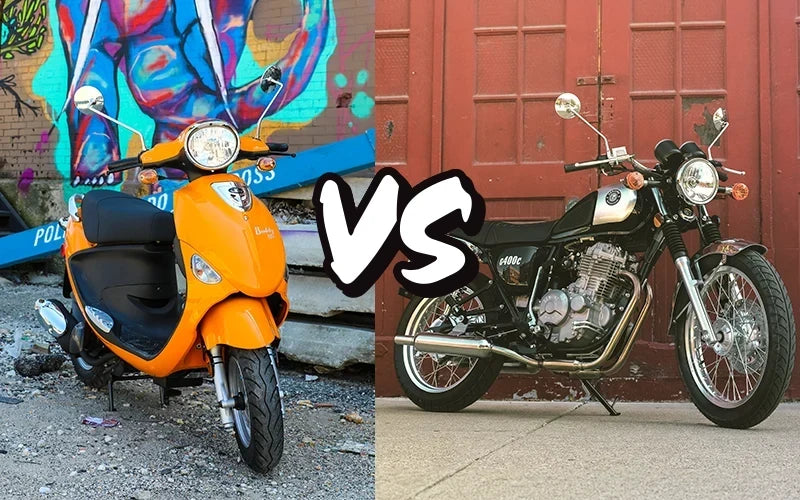
At first glance, scooters and motorcycles might look like two versions of the same thing. Both have two wheels, handlebars, an engine or electric motor, and are designed to get you where you're going without taking up much space.
But there are some important differences between a scooter and a motorcycle.
The biggest differences come down to design, engine size, transmission, riding position, storage, performance, and how each vehicle is typically used. Understanding those differences can help you decide which type of two-wheeled vehicle makes the most sense for your commute, lifestyle, and riding goals.
What Is a Scooter?
A scooter is a two-wheeled vehicle designed with an easy-to-use, step-through frame and a floorboard where the rider can place their feet. Most modern gas scooters use an automatic continuously variable transmission (CVT), meaning the rider doesn't need to manually shift gears.
Scooters are available in a wide range of engine sizes and can also be powered by electricity. Smaller scooters are often used for short trips, city transportation, and commuting, while larger scooters can handle longer distances and higher speeds.
Genuine Scooters offers models ranging from lightweight 50cc scooters to larger-displacement options designed for riders who need more performance.
One of the biggest advantages of a scooter is its simplicity. Twist the throttle and go—there's no clutch lever or manual gear shifting to manage on most automatic scooters.
What Is a Motorcycle?
A motorcycle is also a two-wheeled motor vehicle, but its design typically places the rider in a more traditional motorcycle riding position, with the legs positioned on either side of the fuel tank or frame.
Most motorcycles use a manual transmission, requiring the rider to operate a clutch and shift gears while riding, although automatic and semi-automatic motorcycles are also available.
Motorcycles are generally available with larger engines and are built for a broad range of uses, from everyday commuting and touring to off-road riding and high-performance riding.
Scooter vs. Motorcycle: The Main Differences
While there are exceptions to nearly every rule, the following differences are common when comparing scooters and motorcycles.
| Feature | Scooter | Motorcycle |
|---|---|---|
| Riding position | Upright, feet on a floorboard | Legs typically straddle the frame |
| Transmission | Usually automatic CVT | Usually manual |
| Engine sizes | Commonly smaller, but ranges widely | Typically larger |
| Storage | Often built-in under-seat storage | Usually requires added luggage |
| Frame | Step-through design | Typically step-over design |
| Controls | Simple twist-and-go operation | Usually clutch + gear selector |
| Best known for | Commuting, errands, urban riding | Performance, touring, longer-distance riding |
| Fuel economy | Often excellent, especially smaller scooters | Varies considerably by model |
These aren't hard-and-fast rules. There are large scooters, small motorcycles, automatic motorcycles, and motorcycles with extensive storage. The distinction is primarily based on vehicle design and configuration rather than a single engine size or feature.
1. Riding Position
One of the easiest ways to tell a scooter from a motorcycle is the riding position.
On a scooter, the rider typically sits upright with their feet resting on a flat floorboard. The step-through design makes it easy to get on and off the vehicle without swinging a leg over a large seat or fuel tank.
Motorcycles generally have a higher, more traditional riding position. The rider sits with their legs on either side of the motorcycle's frame or fuel tank.
For many riders, the scooter's upright seating position and step-through design make it particularly convenient for everyday transportation.
2. Automatic vs. Manual Transmission
Another major difference is how the vehicle delivers power to the rear wheel.
Most gas-powered scooters use a continuously variable transmission, or CVT. Instead of manually selecting gears, the transmission automatically adjusts as the scooter accelerates.
That means riding a typical automatic scooter is essentially twist and go.
Most traditional motorcycles use a manual transmission. The rider operates a clutch and selects gears using a foot-operated shifter.
Neither system is inherently better. They simply provide different riding experiences.
If you want straightforward transportation without learning to coordinate a clutch and gear changes, an automatic scooter can be an appealing option.
3. Engine Size and Performance
Engine size is another area where scooters and motorcycles often differ.
Scooters commonly come with smaller engines, particularly models designed for urban transportation. A 50cc scooter, for example, is designed for a very different purpose than a 600cc or 1,000cc motorcycle.
However, engine size alone doesn't determine whether something is a scooter or motorcycle. There are larger-displacement scooters and smaller-displacement motorcycles.
Generally speaking, motorcycles offer a wider range of high-performance options and are more commonly designed for higher speeds, long-distance touring, and performance-oriented riding.
Scooters tend to prioritize accessible performance, efficiency, maneuverability, and ease of use.
4. Storage
Storage is one area where scooters have a practical advantage.
Many scooters feature under-seat storage that can be used for everyday items such as a helmet, rain gear, or small personal belongings. Additional racks, bags, and top cases can expand that capacity even further.
Motorcycles typically don't have significant built-in storage. Riders often add saddlebags, tank bags, tail bags, or top cases when they need additional carrying capacity.
For someone using a two-wheeled vehicle for errands or daily commuting, integrated scooter storage can make a noticeable difference.
5. Size and Maneuverability
Scooters are often smaller and lighter than motorcycles, although this varies considerably between models.
A compact scooter can be particularly useful in an urban environment where riders regularly navigate tight parking spaces, crowded streets, and stop-and-go traffic.
The combination of a lightweight chassis, upright riding position, automatic transmission, and relatively small footprint can make scooters well suited to city riding.
Motorcycles range from lightweight commuter models to large touring bikes, so maneuverability varies widely.
6. Fuel Economy
Fuel economy is another reason people choose scooters for everyday transportation.
Smaller scooter engines can use significantly less fuel than many larger motorcycles. The exact fuel economy depends on engine size, vehicle weight, riding conditions, speed, and other factors.
For riders primarily traveling around town, a scooter can provide an economical way to cover short and medium-distance trips while using less fuel than many larger vehicles.
Of course, electric scooters eliminate gasoline altogether and offer another option for riders looking to reduce fuel use.
7. Which Is Easier to Ride?
For many new riders, an automatic scooter can have a gentler learning curve than a traditional manual motorcycle.
There is no clutch to operate and no gear shifting to learn. The rider can focus more of their attention on throttle control, braking, steering, traffic, and road awareness.
That doesn't mean scooters don't require training.
A scooter is still a motor vehicle, and learning to ride safely is important. New riders should understand their local licensing requirements and consider taking an approved motorcycle or scooter safety course.
8. Is a Scooter a Motorcycle?
This is where things can get a little confusing.
In everyday conversation, scooters and motorcycles are usually treated as different types of two-wheeled vehicles. From a legal standpoint, however, the definitions can vary depending on where you live.
Some states classify certain scooters and motorcycles under the same general licensing or registration requirements, while others have different rules based on engine size, maximum speed, equipment, or vehicle type.
Always check your state's laws before riding. Requirements can include licensing, registration, insurance, helmet use, and other equipment.
Scooter or Motorcycle: Which Is Right for You?
The right choice depends on what you want from your ride.
A scooter may be a good fit if you:
- Primarily ride around town
- Want an automatic transmission
- Prefer a step-through design
- Want built-in storage
- Value fuel efficiency
- Want something easy to maneuver and park
- Use your two-wheeler primarily for commuting and errands
A motorcycle may be a better fit if you:
- Want higher-performance options
- Plan to take longer highway trips
- Enjoy manually shifting gears
- Want a traditional motorcycle riding experience
- Plan to ride long distances or tour
- Want a wider selection of performance-oriented motorcycles
Of course, there's plenty of overlap. The best vehicle isn't necessarily the one that fits neatly into a category—it's the one that fits how you actually plan to ride.
The Bottom Line
So, what's the difference between a scooter and a motorcycle?
Scooters typically feature a step-through design, a flat floorboard, automatic transmission, and convenient built-in storage. Motorcycles generally use a traditional frame, manual transmission, and offer a broader range of engine sizes and performance capabilities.
Neither is universally better. They're designed around different priorities.
If most of your riding consists of commuting, running errands, getting around town, or simply enjoying an easy ride, a scooter can be a practical and fun alternative to a motorcycle or car.
And if you're still deciding what type of scooter is right for you, Genuine Scooters offers a range of models designed for different riders, commutes, and riding styles.






Leave a comment
This site is protected by hCaptcha and the hCaptcha Privacy Policy and Terms of Service apply.